The Relationship Behaviourist…
Delivered by South London Dog Training
My Process And Methodology
To set you up for long-term success, all new clients—regardless of the service required—begin with a structured, two-step initial process.
Step 1: The Diagnostic Consultation (1 Hour)
A thorough diagnostic assessment covering your dog's history, environment, background, triggers, diet, medical history, and an owner personality test. We explore the unique communication profile between you and your dog to build a tailored training plan that balances high-value rewards with clear communication, calm leadership, and boundaries.
Step 2: The Practical 1:1 Training Session (1 Hour)
With a clear blueprint of your dog's psychological needs, we get straight to work. This hands-on session puts our findings into action—building new habits, establishing clear communication, and laying down fair boundaries for lasting change from day one.
Our initial meeting is two hours.
The Training Environment & Process
Our sessions are designed to be flexible. We can meet in whichever environment best suits you and your dog's training needs:
In-Home Assessment: We complete the diagnostic consultation in your home. After our initial consultation, we go straight to work on your local streets or in your nearest park for our hands-on training session.
Brockwell Park (Brixton): We meet in a neutral, public setting atThe Glassmaker’s Café, Brockwell Hall inside Brockwell Park, to work on social communication and real-world distractions.
Alternative Park Location: If you prefer a different training environment, we can meet at an alternative, agreed-upon park location across South London for both the consultation and practical training session.
Follow-Up Sessions
Follow-up sessions are typically 1 to 1.5 hours, scheduled 1–2 weeks apart. Most clients successfully achieve their behavioural goals within 6 hours of total session time.
Session Preparation & Equipment
To get the absolute most out of our practical training sessions, please prepare the following:
What to Bring: Please bring your dog's standard walking equipment (such as their regular collar, harness, or lead) along with a generous supply of their absolute favourite high-value training treats.
Exercise Adjustment: Please do not take your dog for a big walk right before our session. A short 10-15 minute walk beforehand is ideal so they are settled but still have plenty of mental energy to learn.
Dietary Note: Please avoid giving your dog any big meals for at least 2–3 hours before we meet, as this keeps them safer during physical exercise and highly motivated by food rewards.
Weather Contingency
Please note that our outdoor training elements are subject to the weather. To ensure safety and comfort for both you and your dog, we may adapt our sessions to meet inside if it is raining heavily, or pivot to shaded, cooler areas if it is hot.
The Psychology of Balanced Dog Training: Building Safety, Focus, and Loving Leadership
True behaviour modification requires a deep understanding of both canine learning theory and human psychology. When I transitioned from working as a clinical psychotherapist to a canine behaviourist, I immediately noticed that the foundational principles of emotional regulation remain exactly the same across both fields.
In a fast-paced urban world, a successful relationship with your dog cannot be built on a single, rigid training ideology. It demands a nuanced, balanced approach that prioritises emotional safety, clear communication, and structured guidance.
A Balanced Framework
A professional balanced framework is heavily rooted in positive reinforcement; in my daily practice, 90% of our work is entirely reward-based. We use high-value reinforcement, games, engagement, and praise to proactively teach new behaviours and build enthusiastic focus.
However, pure positivity without boundaries often fails when real-world safety is on the line. In my experience, a purely positive approach leaves many dogs—particularly those struggling with anxiety, leash reactivity, or deeply ingrained behavioural issues—without the structure and clarity they look for.
Corrections or boundaries are used calmly, minimally, and precisely, only when a situation genuinely demands it for safety and after a dog completely understands what is being asked of them. A correction is never about anger or intimidation; it is a fair boundary designed to interrupt dangerous behaviours—such as lunging towards traffic, glass, or other animals. Just as a human therapist helps clients identify boundaries that keep them safe, a balanced trainer uses fair boundaries to protect a dog from its own impulsive choices.
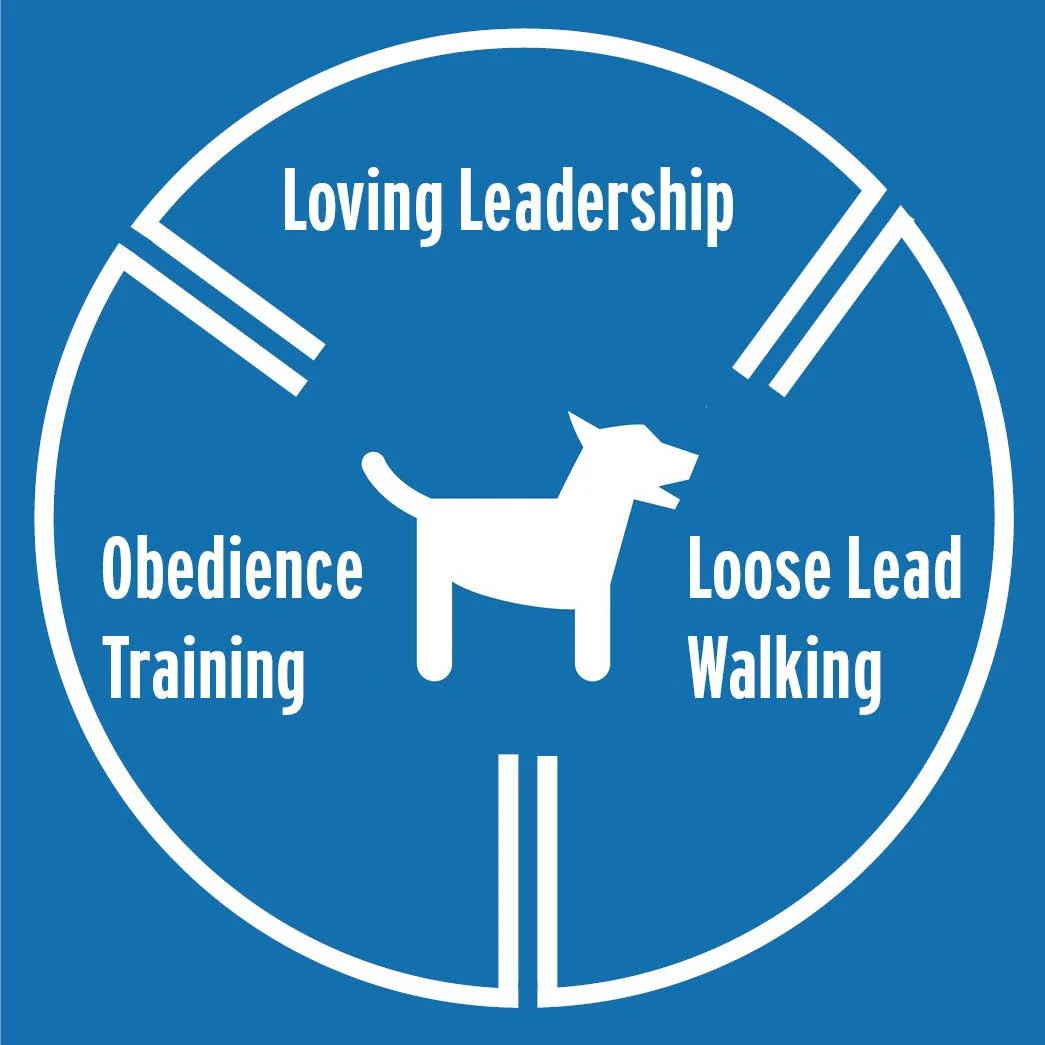
The Three Foundations of My Method
When you get these three core pillars right, the vast majority of behavioural issues either resolve themselves or become significantly easier to manage. On average, most of my clients successfully reach their specific goals within 6 training hours.
Loving Leadership: Dogs need structure to thrive. This isn't about dominance or harshness—it's about calm, consistent, confident leadership that makes your dog feel safe enough to step back, switch off, and relax.
Reliable Obedience: A dog that responds to basic commands can be managed in challenging environments and trusted in the real world. Obedience isn't about control for its own sake; it is the bedrock of a relaxed, confident dog.
Calm Loose-Lead Walking: This is where most owners struggle, and where relationship tension originates. A tight lead feeds stress and reactivity straight down the line. Transforming how your dog travels on the lead instantly shifts their mindset from a chaotic survival mode into a cooperative headspace.
Ultimately, balanced training is about empowering you to become a calm, confident leader. By focusing heavily on rewards while maintaining fair boundaries when safety demands it, you provide the predictable, secure environment your dog needs to truly thrive.